
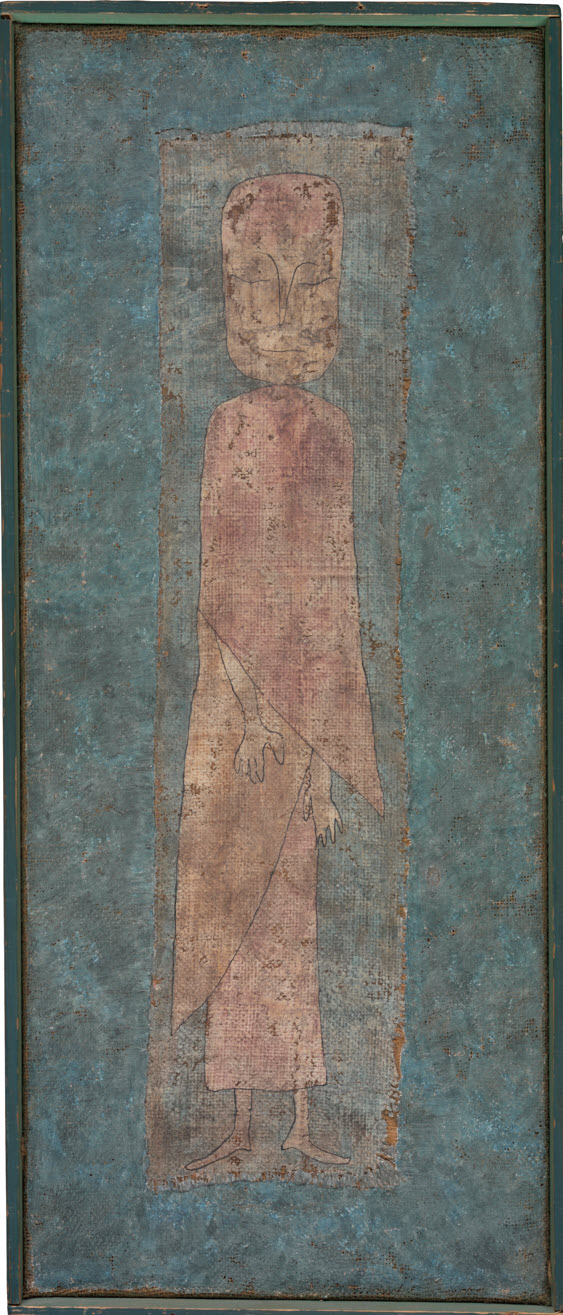
Paul Klee, Büsser (Pénitent), 1935. I renamed this ashen, ethereal work “Soul.” (Source 1, at the end of text)
Penitence! In The Sign this word refers to the festive enduring time a man spends changing his life (30/11) by loving, forgiving, making peace, setting himself and the world spiritually free, by viewing everything and everybody with spiritual intelligence. That’s the way I’ve come to understand the myth of the sphinx.
I have understood that what the sphinx used to challenge the passers to see and they used to fail to see was lying, untruth. Œdipus saw it, so the sphinx in a pique jumped down from her mount and seemed to go extinct. The myth was just a prophecy, about which all of men would keep on forgetting until The Sign appeared.
Lying is the worst sin, so much so that the Maker has not applied to anything but lying this paroxysmal phrase: the lie of all lies (the falsehood of falsehood, Sign 32/7), whereas he has never said the war of wars, the theft of thefts, the adultary of adultaries, the misfortune of misfortunes, because every war, every theft, every adultary and every misfortune has its origin in some lies.
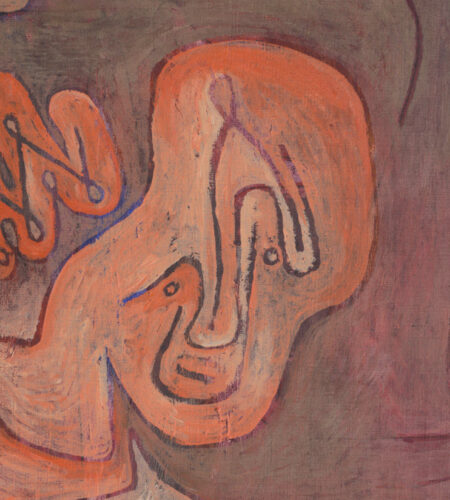
The sphinx is still to be conquered. The Day of happiness will continuously be delayed until the sphinx is conquered. It only remains for man to understand that lying is not to be an endless evil, for which men should forever ask God and their kind to forgive them.
Ever since 1974, when The Sign came to me, I understood that the new coat (Sign 1/1), that the new penitent was to put on, was no longer the piece of clothing of religious penitence, the robe of remorse and expiation, but the coat of Life (Sign 24/3-5), of self-re-creation, of the Light and Truth restored.
Truth, man has been unable to see it for ages, because he has been unable to see untruth, lies. Does this argue against itself? No, it doesn’t. The blind man cannot see the night dark or the day light. But Truth will be growing more and more perceptible to the penitent man, as untruth goes on more and more perceptible to him.
There are lies everywhere, long made commonplace so much so men cannot see them anymore. Whenever men are told of lies, they act the stunned people, they reply that lies are the unavoidable circumstances, the normality therefore, of all of human affairs.
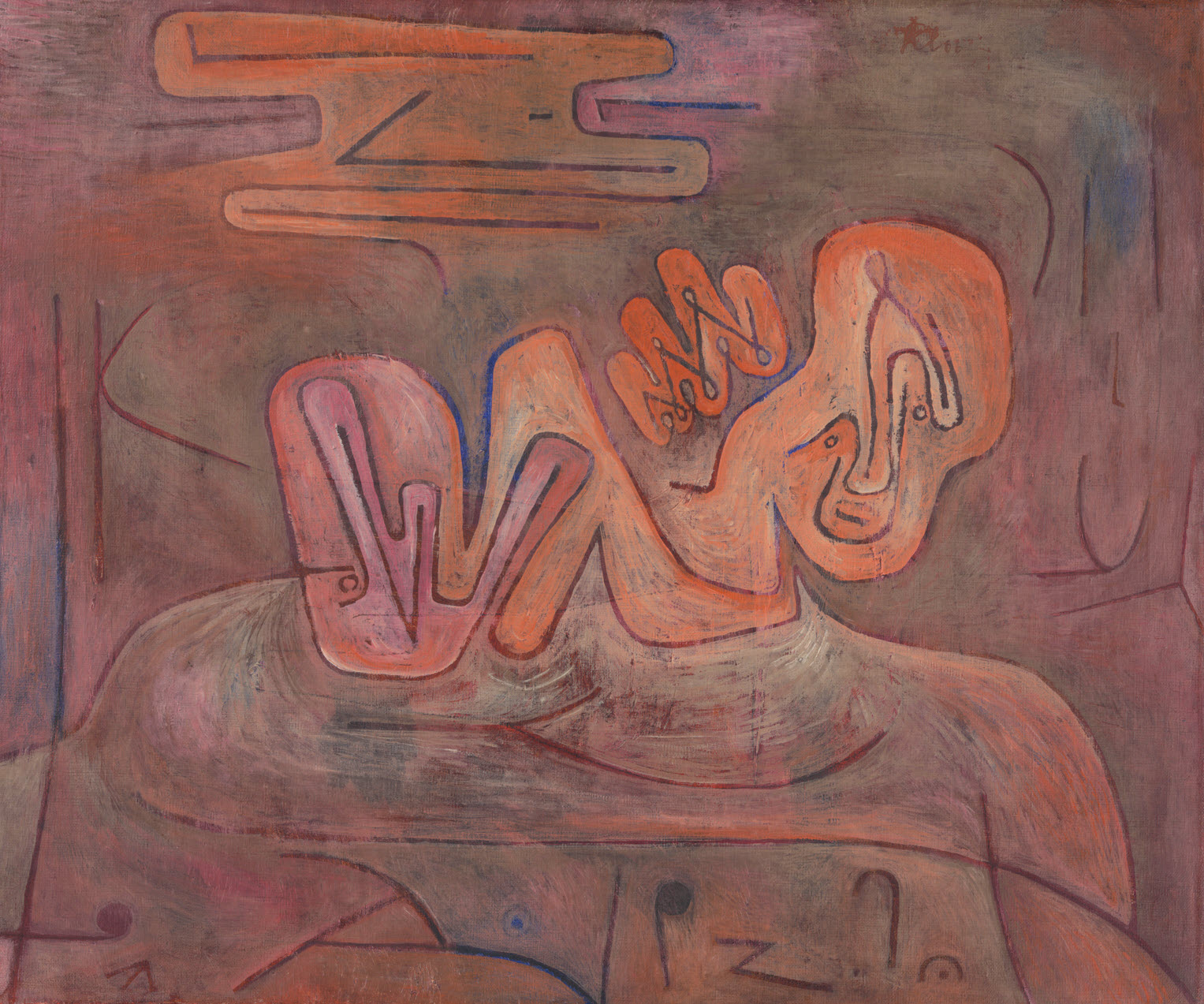
Paul Klee, Katastrophe der Sphinx (Catastrophe du sphinx), 1937. (Source 2, at the end of text)
A month ago, as I was talking with a pious catholic, I pointed out that the church’s doctrine was just a bunch of arguable ideas, some of them gloomy (the atonement through the cross), some others fairylike (the works of the holy ghost),. He answered gravely, “You may be right, but if faith could not be expressed by something more or less intricate, she might become empty, become the gullible ones’ simple faith. Is there anything more dangerous than emptiness?” I retorted, “Your answer sounds like you were unconscious of an alarming reality: The issue is not emptiness, but untruth, lies.”
Currently in France, the electoral campaign for the presidency is being in full swing. Lying is named pledge. Although they all have participated in governements, the leading candidates unembarrassedly state that the great deal of pain France has suffered is just misgoverning. But all of those mistakes will be corrected, prosperity and happiness will be back, if people elect the right candidate, that is, the candidate now speaking.
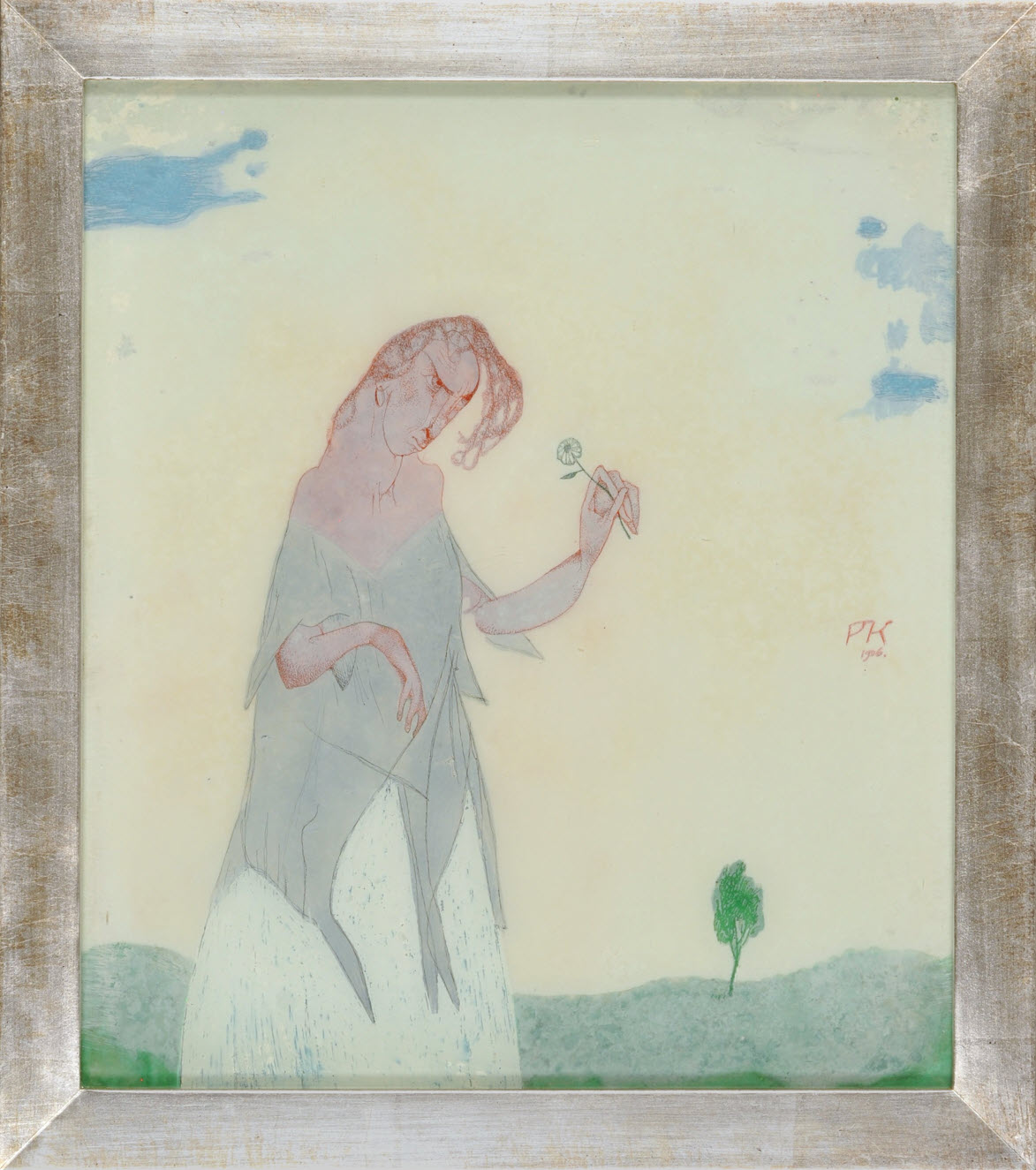
Paul Klee – hésitation (Source 3, at the end of text)
“Alice” at the flexible pace of her bandy legs, in her huge flying crimson dress and blond wig , has promised people a dream rental system charge, combined TV, Internet and all that sort of thing? A number of “Alice” subscribers have paid the system charges for months and waited in vain for the hookup or a refund, but “Alice” keeps on crowing over herself as the best choice. “Nothing but some commercial lies,” I can hear people say shrugging, “Insignificant lies!” To me there are no such things as insignificant lies; there are only lies.
As a penitent, a sinner therefore, I have been struggling against the lying reflex I’ve inherited from culture, which since immemorial time has made man heedless of the fact that the littlest piece of lying contains all of the organism—the mechanism—of the biggest lies just as a small butterfly contains all that made a tyrannosaurus and makes a venomous snake or a stinking cowardly hyena or an army of uniformed brutes invading a country so as to “bring its people democracy.”
What will among mankind restore global happiness lost ever since Adam’s days is love of Truth which goes together with love of the neighbor. Now, “only one thing separates man from Truth: lying, which is more worrisome than greed, which modern socialism considers as the ultimate evil, because if the greedy man never told lies, he could recover from greed sooner or later.” (the peroration of the 1995 General Introduction, The Sign).
Paul Klee entitled this work (3) “Empfindsame Jungfrau mit dem Massliebchen” (A sentimental virgin with a daisy, 1906). I have given it a different title, “Hesitation,” because I seem to have constantly seen the girl, with her dangling right hand, still useless, on the verge of the cardinal decision of the human, who is about to come into adult life, telling herself, “Will I be true or a liar?” It does not matter what she is hesitating over; one is always hesitating before the true or before the false. The flower that she is staring at only helps her focus her thinking on the Core of the Cores (Sign XXXIV/6).
Paul Klee is one of my favorite painters because of his capacity to express the inexpressible, to change the matter and the light in deep thinking. There has been in Bern, Switzerland, a magnificient museum dedicated to Paul Klee for a short while. I do not have enough time to go there and visit the museum , but my Swiss sisters and brothers have given me an album of the museum. I am very touched by their thoughtful gesture.
(1) Paul Klee (1879–1940)
Büsser, 1935, 143
Penitent, 1935, 143
Watercolor and pen on prepared burlap; original frame
85.5 x 35.5 cm
Zentrum Paul Klee, Bern
Photo credits: Zentrum Paul Klee, Bern, Image Archive
(2) Paul Klee (1879–1940)
Katastrophe der Sphinx, 1937, 135
Catastrophe of the Sphinx, 1937, 135
oil on prepared cotton
50 x 60 cm
Zentrum Paul Klee, Bern, Donation Livia Klee
Photo credits: Zentrum Paul Klee, Bern, Image Archive
(3) Paul Klee (1879–1940)
Empfindsame Jungfrau mit d. Maßliebchen, 1906, 21
Sentimental Virgin with Daisy, 1906, 21
painting under glass; reconstructed frame
23.7 x 20.4 cm
Private collection, on loan to the Zentrum Paul Klee, Bern
Photo credits: Zentrum Paul Klee, Bern, Image Archive
Translated with DeepL.com (free version)
© Michel Potay 2007 — Tous droits réservés