
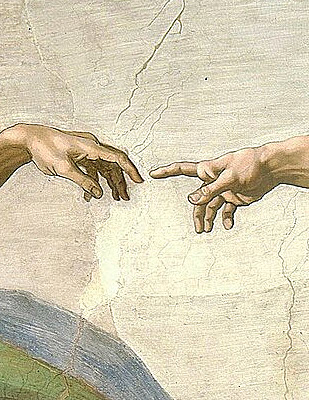
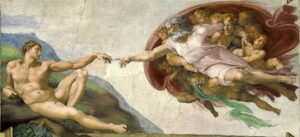
Such misrepresentations of God have demonstrated the incapability of religion to escape from primitivity and superstition and keep atheism from spreading. What’s more, here (Sixtine Chapel, Michael-Angelo, Vatican) we wonder whether God is creating Adam or Adam creating God.
Source : Michel-Ange, Sistine Chapel (Public domain, Wikimedia)
In 1974, somebody speaks to me through Jesus (Sign 2/15). In 1977, somebody—he introduces himself as the Return (I/1), so he can’t not be but the same—speaks to me directly; it’ll be thirty years come October. Somebody that has fathered all of Earth, all of life, all of man (4/10) and even the universe (12/4, not to mention his fatherhood over me reduced to nothing by him (40/6) so as to cleanse my heart (L/1) ! Somebody that doesn’t trouble himself about being mistaken for anyone else, at all, so that he names himself simply I or Me (2/13, XXXVIII/3, etc.). This is God, yes…and no. Whenever human words emerge, notably the word God, all gets into a muddle: Jesus was made a God (2/13), but he is not God (32/2), and then all turns vaguer… This a Christ who is God born to Jesus, which, when taken literally, sounds as if it meant that God sprang from the imagination of a man, Jesus, born to a woman called Mary (32/2). Indeed, these words have quite another meaning, which man’s spiritual intelligence reduced to a dull candle end, cannot understand (32/5).
Sensible, therefore, were the early Christians as they used to know by intuition that Jesus had got something to do with God, but to see to it that it remained an intuition. Senseless, accordingly, was the church as it changed the intuition, where the Truth could swim, into a dogma—the trinity (23/7, XVIII/1), the redeeming cross (XXXI/1) —, where the Truth has been a wreck awaiting refloating. The refloater, The Sign, has come in. If the church, which was God’s grand crop (14/3-4) before God began getting in the Arès Pilgrim harvest, can hear the Call (4/4) and doing so it will take to slowly pulling up to the surface the intuition, the faith of Abraham, of Jesus, the faith in the Good (XXXIII/1) and its maidservant: beauty of words and actions (12/3). We believe that the Creator did not speak to no avail in Arès, and that religion is to open up somehow or other to the thousand suns of the Breath that melt (2/14) the obscure dogmatic language (2/14) into an intelligent language (23/4), the Life that for the time being is still hiding beneath the desert of words (24/3-5). The very concept of God, which most men keep on disproving, is in the greatest need of refloating. Meanwhile, we’ll see below that it is not always an error to say that God is a product of imagination, but that for all that God is no less real.
Until 1974 I couldn’t imagine being unaware of what and who God was. But ever since I was given The Sign I’ve been broadly unaware of it. All I know now, using my poor spiritual loaf (32/5), is some things he says like: Truth is that the world has to change (28/7), and some things he makes like to love man too much (12/7) and create the universe uninterruptedly: I (am still) run(ning and while running) I make a thousand new suns (XXII/12), but I suspect he is and can make and can give us a lot more.
The Sign often says God with the religious pomposo or a skeptical sotto voce, so as to reproach us for blathering about God . We can easily understand why The Sign likes the term Father better: Father of the universe, You are the only Saint (12/4). God sometimes refers to himself as I have, I am (II/1)… it is I who is speaking (XLVIII/3), which are good matches for “You shall tell tehm that I-am sends me to you (Exodus 3/14).” Some people ask me, “Where in his Word has I-have-I-am put the list of all he has and all he is, so that we may definitely identify him?” I reply, “There is no list, because the Father as an absolute owner and being has and is absolutely.” The reply, I know, sounds like argumentation rather than insight. It is a reminder of the ontological or teleological arguments of the theists and deists. For instance, this argument as flimsy and barren as it is famous: “God exists, because he is necessary,” which I thought was false in the days when I was an atheist Communist, and then true after I converted to Christianity around 1962, and which I think now is both true and false, as God has become necessary to me, since I saw him (37/3), but has remained unnecessary to those in large numbers who contend that I must have seen things.
As regards atheist Communists, lately my children recalled me as a young man being fond of René Char (a French poet who died lately) and gave me his complete works (La Pléiade) as a present for my 78th birthday. When I find time to reread Char again, I will for sure find his professions of atheism, which I used to share. This I can quote from memory: “Men have cooked God up and garnished him—rather badly, he added—with their human phantasms.” Atheistic Char was a great poet, however, he had intelligence and sensitivity of high quality, living proof that an individual can be a good man, even though he does not recognize the Voice of God (28/1-12).
Heidegger and Sartre, whose existentialism The Sign has decisively added its own existentialism, were they atheists? “Yes,” a priest, a pastor, a rabbi, an imam would answer. “No,” an Arès Pilgrim answers. Heidegger and Sartre disproved the God of religion, but The Sign, which is nothing atheistic, not by a long way, disproves the God of religion even more. Heidegger mentioned a reality ultimate, but reachable, the Being. Sartre, even though he considered the concept of a God as the ruler of man and his destiny as impossible, because it denies man’s free will, which is quite obvious, would not have disowned the God that insists on man’s obvious free will, when he says, “Adam chose… (2/1-5).” Neither is The Sign at variance with Sartre’s idea that essence cannot have been created before existence—”Existence comes before Essence”—, because a man can at any time decide on his “fundamental project,” which for us Arès Pilgrims is individual as well as worldly salvation, and can even “decide on his own character,” which we Arès Pilgrims strive to do through penitence.
Hegel said—in his “Little Logic,” I think—that the finity of things and beings is that their existences are distinguishable from their notions, but as regard God his notion and his being are inseparable. By this, I think, you can tell God and you can tell God by this in man himself. Hegel did not produce proof of God, but he gave what I believe is the right way of spotting him, his right image (Genesis 1/26-27), the indivisible Whole which God’s being and thinking make up, the whole that a penitent recovers while recovering the image of his or her Maker. It culminates in God’s being experience.
God is experience for me, the witness of The Sign, but he has been, he is, he will be experience for a lot of people in a lot of ways, whether prodigious or very private. The snag is that most of those people have kept their experiences hidden (2/16-18) from a world ruled by psycho-socio-political received ideas where free speech about God is considered as “totally irresponsable” and “unbearable” as free speech about love between men or absolute freedom. This is why The Sign states in substance that it doesn’t matter whether you fail to prove God, because the objective is Good. Besides, whoever seeks Good seeks God, even unconsciously. The Arès Pilgrims seek Good through penitence, but apart from them myriad people pay no attention to it and the believers among these people do not even realize that so doing they have got more than dangerous gaps in their knowledge of God, they live in emptiness—Hence a need of the theater of religion in order to fill emptiness and men’s anxiety before the emptiness of death— It’s pointless explaining and proving God to people who ignore Good. The small remnant of penitents who are harvesting new penitents cannot carry out their mission, if they are not testing people for their interest in Good. Only later will they grow conscious of God and still later will they get knowledge of God.
© Michel Potay 2007 — Tous droits réservés