

This religiosity and The Sign are poles apart, but its spiritual insurrectionary courage is worth pondering.
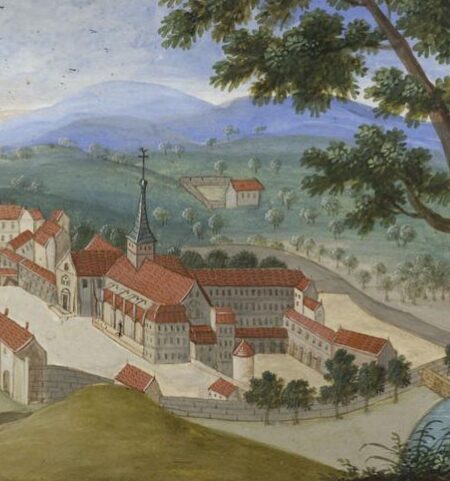
(Public domain, Wikimedia)
Pondering over some people and ideas, that you instinctively would rather flee from, is a good love and respect for others exercise and even intelligence exercise.
On this day when the church christendom celebrate the Ascension of Jesus drawn up to where the saved man no longer drinks air (Sign vi/1) I am going into communion with the Catholics, not into communion of dogmatisme but of immanence—brother and sister humans on both sides of whatever distinguishes between them—and pondering a point of their history: Port-Royal.
Well, as an Arès Pilgrim forever making efforts to be free (Sign 10/10), free from every prejudice and in continual quest for absolute freedom, because I as an existential man am redoing my destiny (Sign 30/11) and the world’s destiny (28/7) I find food for thought in Port-Royal like in any other experience of faith in search of freedom in the image and likenes of the Creator, that is, indomitable freedom.
Though gone ever since the 17th century, Port-Royal in unison with all those who appeal to universal conscience, which no law of the rats (Sign xix/24) will ever subdue, has endlessly proclaimed the absolute dignity and freedom of man faced with the earthly powers, religious, political, intellectual, whether past, or present, or future.
I can just imagine the habitual protests, “What now? You’re pondering over that convent Catholic and moreover jansenistic (predestinarian), where faith lost its way and was the antipode of The Sign?”
Please don’t judge me rashly! I lament the excess of error, that the Port-Royal nuns had made in order to escape the sins and corruptions of their times and of their own church,
so I protect myself from the temptations of strange radicalism to which those who have given up all hope of seeing the world change for the better can give in,
and I find a fresh opportunity of praising the Father who, in Arès, has reminded men that it’s no use resorting to theological designs, because only the good deeds—penitence —save,
but at the same time I ponder the superb courage displayed by Port-Royal in spiritual revolt.
Free to forget about Port-Royal are all of those appalled by or uninterested in Port-Royal, but I personally find it appropriate to reflect on two basic points:
Port-Royal, the counterexample:
Let’s make no mistake, the Arès Pilgrims’s absolute counterexample is not the Port-Royal nun ; it is Adolf Hitler. But Port-Royal, what a counterexample of faith! The Port-Royal nuns used to abide by the Catholic dogmae: Trinity-God (the god with three heads, Sign 23/7), redeeming through the death of God himself on the cross, the magisterium of the church and pope to be reckoned with, etc., beliefs that The Sign alienates us from. But the nuns’ error was even more serious. The Port-Royal nuns believed in the teaching of two clerics, Cornelius Jansenius (le brain) et the Saint-Cyran abbot (the brain’s fiery preacher), who claimed that salvation not only depended on God’s goodwill, but also on some predestination. This is the exact opposite of the Arès Word’s teaching, that reminds us that salvation of individuals or mankind only depends on man’s goodwill and that any human has salvation ahead on him or her only by dint of efforts of penitence which is a joy to pious people (Sign 28/25).
Port-Royal, the example :
Port Royal showed peaceful, though resolute resistance to power religous and political. The nuns and their friends set up an example of spiritual insurrectionary strength, though they were deprived of any temporal force just as we Arès Pilgrims are, is an example of “opposingness” (The Arès Pilgrim 1989, p.236) and extreme courage worth pondering.
Port-Royal ended up blotted out from society by the princes, but not blotted out from men’s minds, if only because it gave sanctuary to characters of outstanding calibers as well as free great minds like Blaise Pascal, the writer of “Thoughts”, a book that would keep on feeding a lot of free believing hearts until today.
Where Port-Royal failed, because that community of faith was based on a dry rigorism, by no means focused on the change of the world (Sign 28/7), we will succeed. The Sign gets us to start from a quite different base spiritual and social: assemblies in control of themselves (Sign 8/1), because they are made up of penitents who do not expect their own salvation and the world’s salvation from Mercy and a predestination Law, but from themselves by diligently acting out of love, forgiveness, peace and warmhearted intelligence and setting themselves free from all prejudices, so enabling themselves to take a fresh, creative look at man and things.
© Michel Potay 2010 — Tous droits réservés